
The Coming Age of Augmentation
3rd October 09
Posted in technology, transformational change

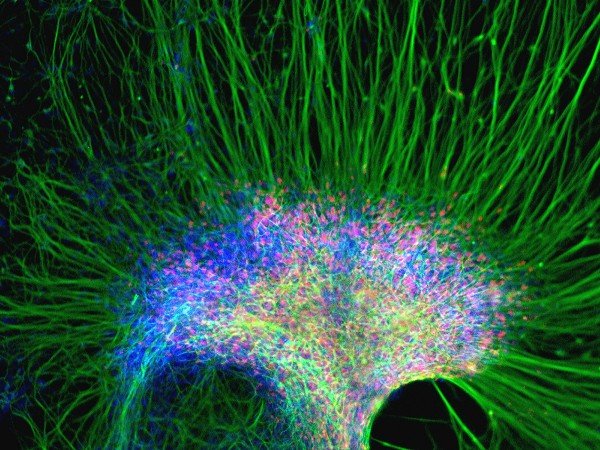
Photo: cluster of neural cells by Su-Chan Zhang, University Wisconsin-Madison
As in thrall as we may be to the firehose of new stuff drenching us in the here and now, occasionally we want to look a little further over the horizon. Two thoughts collided in the collective Labs brain a short while ago. By ‘collided’ we mean we saw a consequence of the relationship between the two that made us sit up and think:
1. The mass socialization of technology. 300 million + Facebook users can’t be wrong. We’re still in awe of how mainstream the adoption of technology has become and just how networked the world is. Increasingly the ‘loop’ never seems to close.
2. How ill-equipped we are to cope with the deluge. Natural human processing power is sadly finite and struggling to cope. Certainly, we know we’re not alone in adopting coping strategies like continuous partial attention and ignoring much beyond tomorrow or next week. Steve Rubel at Edelman also has written extensively on the attention crash and its relevance for marketers.
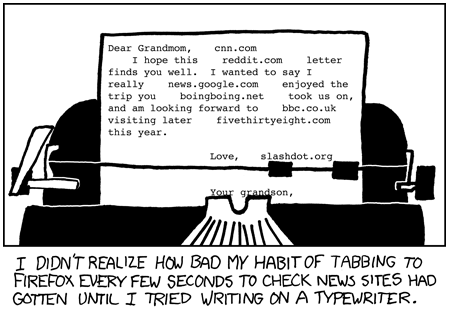
Courtesy of xkcd web comic
The heady mix of excitement and uneasy tension brought about by these two things has felt irresolvable and on an accelerating curve. Sure, we can help speed our path through the data with better micro tools (“there’s an app for that…”) but they invariably lead us to consume more, faster; giving us the sense that we’re simply accelerating to the point where our brains implode are placed under too much stress. We’re not wannabe priestesses and priests of Zen around here, but is there a longer term, more profound step change to be made where technology actually enables a more balanced life?
An answer began to emerge when we read a thought-provoking piece in the NYT by John Markoff subtitled “Artificial Intelligence Regains Its Allure.” AI. Cybernetics. Nanotechnology. Post Humanism? Sounds eccentric, but stay with us. Markoff’s assertion that a groundswell of attention and respect has been building around AI, in particular around an idea dubbed the Technological Singularity, made us curious. In a sentence, the idea is that once we create an an artificial intelligence greater than our own, it follows that any resulting ‘Superbrain’ will be capable of augmenting itself extremely quickly to become even more intelligent and so on, leading to an explosive growth in intelligence that is (literally) beyond our imagination.
The surge in interest around the Singularity has led one of its most earnest proponents, Ray Kurzweil, to produce a film about it, due for release in early 2010:

Whether this turns out to be science fiction or science reality, we figure it’s time we paid more attention. As the futurist Alvin Toffler puts it: “It’s not only OK to think about the future but, the more you do, the more ideas you’ll have about the present.” Back to that in a bit.
Our interest has a lot to do with timing. The idea that machines might become self-aware and/or that humans might dramatically augment their intelligence is not new, the simple difference is that it may happen well within our lifetime. Indeed, the shrinking time frame was the thing that grabbed our attention first.
“How soon could such an intelligent robot be built? The coming advances in computing power seem to make it possible by 2030. And once an intelligent robot exists, it is only a small step to a robot species – to an intelligent robot that can make evolved copies of itself.”
Bill Joy, Why the Future Doesn’t need Us, Wired, April 2000
“We have a lot of debates about that [when a computer is expected to pass the Turing test and demonstrate intelligence equal to a human's]…some people at Google say not for 100 years, but I’m more optimistic. I’d give it 20 years. Partly due to the improvements in technology. And partly” – he laughs – “to the decline of humans.”
Sergey Brin, Wired interview, August 2009
Inevitably, the questions start to pile up at this point. Given this topic can be the territory of “futurist-nutjobs” (thanks @brainpicker for the technical term), we’ve fileted the background reading we found most useful into a separate Labs post here, which you’re welcome to check out if you want to delve deeper without the full, sand-blast-your-neural-cells experience we endured to bring this to you. We’ve included how the Singularity may come about, examples of companies from start-ups to Google taking it seriously, Kurzweil’s logarithmic graph that depicts the pattern of exponential change leading to the Singularity, what the sceptics say and what the alternate scenarios may be.
Rewind to 2009. Whether or not everyone can agree upon what a Technological Singularity is, let alone whether or not it will occur, most seem to agree on this: we are already transitioning to an era when we will need to develop new cognitive habits, our brains augmented, aided and abetted by technology to achieve this: an Age of Augmentation, if you will.
We particularly like Jamais Cascio’s thinking here. He describes a technological evolution focused upon how we manage and adapt to the immense amount of knowledge we’ve created, what scientists term “fluid intelligence” – “the ability to find meaning in confusion and to solve new problems, independent of acquired knowledge:”
“Fluid intelligence doesn’t look much like the capacity to memorize and recite facts, the skills that people have traditionally associated with brainpower. But building it up may improve the capacity to think deeply that Carr and others fear we’re losing for good. And we shouldn’t let the stresses associated with a transition to a new era blind us to that era’s astonishing potential. We swim in an ocean of data, accessible from nearly anywhere, generated by billions of devices. We’re only beginning to explore what we can do with this knowledge-at-a-touch…
…Strengthening our fluid intelligence is the only viable approach to navigating the age of constant connectivity.”
Looking further out again, a Technological Singularity provokes some extraordinary questions vexing scientists far smarter than we are. Whether wholly artificially created or partially human, the debate centres around how to ensure a super intelligence uses its intellect for good, not evil. The prevailing wisdom as brought to us by Hollywood in the Terminator films, A.I. and I, Robot suggests a super intelligence will, de facto, leave the human race behind or destroy us “for our own good”. Putting Hollywood to one side, one argument rather chillingly asserts that a super intelligence would be immortal, have no need to procreate and hence have no evolutionary need for love….. Certainly a killer question must be: how can a super intelligence be created that has a capacity for altruism? In other words “a friendly artificial intelligence” (Eliezer S Yudkowsky, the Singularity Institute)?
Back to the present. Where does this leave us personally and with the brands we work with? (Prepare ourselves to Cyborg-it up in order to cope with the data glut, or pack up and run to the hills?) What role can or should a brand play in either scenario? What should we be thinking about now to prepare for the future that might be closer than we think?
We’re still pondering, but our early thoughts below:
- Join the debate: in an increasingly networked world, everyone can & will have an opinion about the role of technology in their lives. Brutally, it’s likely there will be considerable angst along the way. Brands can help people navigate the practical and philosophical questions, provide tangible tools to help. They can also invest appropriately. (‘Technological Responsibility’ will become the new corporate buzz word).
- In an AI world, more and more low level tasks will be automated, completed by robots. Certain choices will become commoditised or outsourced: the typical example – repeat purchase items / FMCGs ordered by your fridge software or managed entirely by your food retailer. Brands will need to think about upgrading the importance/value/cost of what they offer to qualify for human attention & decision making in the first place.
- Tech augmentation of your product – let your mind run free. How would you integrate healthcare tech usefully into a razor or cereal packet? How can your product take low level decisions helpfully away from your consumer? Direct Debit – the first electronic example of this, but what else?
- Counter-culture: for now at least, there’s room for brands to be marketed as tools to help Neo-Luddites swim against the tech tide. Guinness, Magners, KitKat – ought to be creating virtual & real walled gardens for when you want to kick back and relax, away from the torrent of data.
- What’s your starting point? Are you part of the hive, a contributor to Google’s all powerful ‘collective intelligence’? Or spokesperson for the outlier, the individual?
- Decide which side you’re on: are you trying to humanise technology or add technology to humans?
However it all turns out, it strikes us we need to stay curious and lean into this, not lean back. As Chris Anderson put it recently:
“This was one of those freaky moments when the future sneaks up and smacks you….Technology wants to be invented and we are almost powerless to stop it. We are hard-wired to create the future, be it good or bad. Invention is its own master.”
Please let us know what you think and check out our other post ‘I Think, Therefore I am (a Self-aware, Superhuman Cyborg) for more on this. In the meantime, we leave you with this, awesome cyborgian stuff from Kraftwerk way back in 1977:
Very thought provoking. Your point on how brands can exploit counter-culture is inspired; I think brands can expand that thinking past neo-luddites.
I embrace technology, but would still appreciate what spending a day (or an hour) without it would feel like.
I could imagine a Hilton-branded counter-culture hotel that it ultra low-tech; but provides that human touch people have come to miss. Imagine a hotel that doesn’t have TV, or internet, and blocks cell reception. That would be a real experience.
Thanks Jordan. I love the idea of escaping for a little while to a space that is ‘always off’, rather than ‘always on’.
I should probably stress that Bill Joy of all people has been called a ‘Neo-Luddite’ (see the previous Labs post http://bit.ly/4dmZ36 for more on this): we use it here to mean someone questioning how technology may unfold in future, not rejecting technology per se.
Interesting post. I’ll take some time over the weekend to think about it and write a longer comment (or probably a post rather).
Some quick random thoughts:
* For me, the basic premise is that we evolve to become more efficient, and that technological evolution is simply part of our overall evolution.
* AI is already evolving itself, but will it reach a singularity when it tips and starts doing this exponentially fast? Maybe. Because as with us humans, one important question remains: As the machine strives to become more and more efficient, what is it trying to become more efficient AT? If the machine can’t figure out the meaning of it’s own existence, it will end up realizing that the most efficient way to use it’s energy will be to terminate itself. It will become depressed. Will the machine then have to invent philosophy to handle the meaning of existence? Or religion? Or…
* Computers and the internet are some examples of brain augmentation, enabling us to handle information more efficiently. Will we want to rest from this? Not sure. Perhaps in these times of change, because change is stressful, but technology and efficiency are not stressful per se.
* Food is one of the most interesting industries for many reasons. But I’m not so sure that the smart fridge is the killer app. Looking instead at the supply side, shopping for food online can reduce the need to keep food in the stores, meaning that on-demand food e-commerce will give us fresher goods at a lower cost, and will minimize waste. Wasted food also carries a huge environmental cost. And really – storing huge amounts of food locally in stores is really not that smart. Using AI to increase on-demand efficiency may well be a killer app for AI in the food industry. I have a whole sketch book full of ideas for food industry e-commerce, so this topic should probably be a post in it’s own right.
Just some early late night thoughts from up north. I’ll check back when I’ve put some more thought into it.
Good night from Sweden.
I’ll jump in with a theory of mine which I have referred to as “digital telepathy.” I believe it falls under the “add technology to humans” category that you’ve laid out above.
Looking at our current state of technology, let’s imagine 2 individuals in the same room each holding an iphone. Let’s say they’re using one of the many methods the mobile device offers to communicate with each other whether it be SMS, email, Twitter, etc. Assuming they are making no sounds or gestures (essentially any kind of signal that human senses could detect) then one could argue that those two individuals are communicating telepathically.
With the above setup however, you have many “middle-men” along the way that make this a very primitive form of communicating. A brain impulse gets sent to a finger, which types a message, which gets sent through a device, to a cell phone tower or wifi, back to another device, to the eye of the receiver, and finally as data that gets sent to the brain.
Fast forward to the not-so-distant future, you have the ability to implant a small device in your brain that acts similar to a bluetooth device. It can broadcast and receive data. It is also hard wired to an organic computer aka your brain. This is already happening to some degree, so the evolution of that technology will almost surely result in certain people opting into merging their own mental capabilities with digital assistance.
Two brains and two digital transmitters = digital telepathy. Perhaps it isn’t the telepathy we read about as kids, but the end result is exactly the same. You’re communicating with someone via sending messages or images without talking.
Great topic and I’m thrilled there are other geeks out there fusing marketing and sci fi. Keep up the great work on the blog.
Great post, a pretty intense read at 2am
Definitely a lot of thoughts in there so I guess I’ll just write some initial reactions.
Regarding AI and robots, it’s sure that’s going to happen sooner rather than later, I don’t know if it will take 30 years or longer but there are a lot of other factors at play that are also interesting.
By that I mean everything is evolving faster all the time and robotics or AI are only aspects of evolution. I read this great post last week about what dogs can teach about the real-time web (http://factoryjoe.com/blog/2009/09/16/what-can-dogs-tell-us-about-the-real-time-web) which is essentially talking about how the way we consume information in a written or audiovisual way is getting unadapted to the speed and amount that we produce and share. It’s pretty much agreed that we don’t use all our brain capacities so alongside potentially having AI robot buddies, we’ll presumably have developed new ways to consume more information faster (think of The Matrix and downloading skills to your brain).
Interesting points about the role of technology and neo-luddites but let’s also remind ourselves that most people aren’t neo-luddites nor are they struggling with the amount of information on the web because they don’t really use it. Reading and commenting on blogs about Ray Kurzweil and/or the future of brands and technology aren’t massively popular weekend activities
Maybe why some people at Google think it might take 100 years before the AI robot uprising.
I like Len’s comment and completely agree with the digital telepathy idea. And going even further, so far we’re thinking AI, robots and computers as mechanical artifacts, but I think we’re going to be developing nano and bio-technology rather than a terminator looking machine (or both).
The device Len mentions isn’t implanted in your brain anymore, it’s a bio-tech evolution and part of your genetic code so it’s transmitting and using your brain rather than a foreign object.
It can be a tricky topic and our ethics about it will surely evolve as well. And regarding brands it’s one where consistency between a company’s actions and its brand message (whatever that message is) becomes even more essential because all the information will circulate even faster than it does now.
Brilliant topic, apparently leading to long comments! I’ll give it some more thought and perhaps write a post about it at some point.
Mel and Team, this is an excellent post and I really enjoyed reading it. I wanted to comment on the two things the collective Lab saw converging:
I look at ‘The mass socialization of technology’ reversed, changing the wording to ‘Technology has made humans into mass socializers.’ Particularly in the U.S. we live in a culture where we live where the work is, picking up and leaving family and friends behind. As humans we cherish these friendships and emotional connections, thankfully networked technology like Facebook allows us to broadcast our life events. This has saved us tons of time where we don’t have to individually email or call all our friends to share the same piece of news. I personally feel this way when my wife and I share mile stone photos of the kids with the extended family. Like most Men, I also hate asking for directions and mobile GPS technology has helped me not socialize with the local gas station or drug store attendant (socialization becomes more selective). In both of these instances, technology has allowed me to live a more balanced life.
The second point was regarding how ill-equipped we are to cope with the deluge. I completely agree that our generation is facing this stress. I realized this when I began to heavily rely on my RSS and Twitter readers. My brain had to be retrained to handle lots of bits of information on a shallow level, and then switch and focus when I wanted to read something more in-depth (like this post). I think, and hope, younger generations will evolve to handle the information overload. Neurologist Barry Gordon at Johns Hopkins School of Medicine in Baltimore says, “out of all the brain’s cells, only 10 percent are neurons; the other 90 percent are glial cells, which encapsulate and support neurons, but whose function remains largely unknown…” I wonder if our brains have been waiting to put them to the Age of Augmentation test?
If I were a futurist thinking about Technological Singularity, I would highlight this possible path:
1) At the beginning A.I. will help us crunch data so we don’t have paralysis by analysis.
2) The supercomputer inside our head will evolve to allow us better handle information. The brain currently uses 20 percent of the body’s energy and in the future it will require more energy. I am not convinced that the Western culture will use this increased brain capacity wisely but we will have more competitive Fantasy Football games and we will be able to remember more details on the celebrities that our paparazzi follow.
3) Humans will again rely on A.I. so they can handle the increased energy requirements and spend our time being social, more importantly being famous inside our social network. More and more non-traditional celebrities will become famous for unusual things. I think the current Intel advertising campaign does a good job showcasing who they consider rock stars in their social networks.
4) Social Economy will replace Financial Economy and we will let the Robots handle everything else outside of being famous.
Right, I’m with Griffin on this bit about younger generations being able to handle it better. In fact I’d maybe even go so far to say humans may have always been wired this way – and the ability to handle these things gets sanded down as we grow and of course, get educated and socialised in whichever particular systems.
Now, I’d never heard about the nueron % thing before, but it kinda makes sense to me. Like, whens the best time to learn languages? as kids, or by total immersion. Plus you always gotta be using it or you lose fluency. What I’m wondering (and I’m sure its written about somewhere) is to what extent are our brains supposed to be used for storage and recall? As opposed to connection-making and problem-solving. Like, isnt the “old” way of learning a brute force method? It cannot be efficient to study a book for weeks and weeks to then practice mostly recall and then some conclusion-drawing. Even the polish guy who said he found the best algorithmic method for studying *stuff, had to base his method on fighting the brain’s natural tendency to file and bury info.
So to wrap up, what I blabbering about is we may not necessarily need tech to augment our brains to be able to handle the deluge, but rather we may begin to see upcoming generations readily handle all this in stride, develop exceptional problem-solving abilities by our standards, and use the continual partial attention optimally.
Of course, the way we measure success (rather than intelligence) in schools and such and therefore the structures and systems will take quite some time to change, but I hope not. Hopefully this makes some sense. Thanks for a great blog post. I’m scared of the appendix post.
Griffin, this comment is a post in its own right… awesome stuff. Your central point adds weight (and a factoid about glial cells…nice) to the theory we touched on about ‘fluid intelligence’. We may not all be fans of the term per se, but the thinking is very attractive (probably because it is very reassuring): that we’re on a road to a different kind of intelligence based upon our ability ‘to see meaning in confusion and solve new problems, independent of acquired knowledge / memorizing and citing facts.’ We’re living in an era where we can already feel the relevance of this. If a future filled with AI can feel too far out (in both senses), then let’s just think a little harder about how our cognitive habits are changing in the near future. Anyone charged with the responsibility of managing a brand needs to have half an eye on this (not to mention anyone in charge of the school system, but that’s a whole other topic).
Finally, I like your future possible path, particularly the part where robots deal with low level decision making and the like, leaving the fun stuff to us. The Social Economy in some respects sounds like a return to a life spent around campfires telling stories to one another, which I for one would prefer. I would certainly like to hear more about it if you have more to share.
I am currently reading this great book that shares my beliefs in a Social Economy, but the author describes it much better than I could. The book is called The Art of Community: Building the New Age of Participation by Jono Bacon. Let me share some of his thinking here:
The benefit of a social economy is belonging.
From the outset, belonging is an abstract concept. We all seemingly understand it, but many of us struggle to describe it in words. I identify belonging pragmatically: as the positive outcome of a positive social economy. In the same way that we judge a strong financial economy by prosperity, wealth and a quality standard of living, belonging is the reward of a strong social economy.
An economy is a set of shared concepts and processes that grow and change in an effort to generate a form of capital. The processes and techniques they use include measuring sales, strategic marketing, enabling ease of access, and so forth. A social economy is the same thing – but we are the product, and the capital is respect and trust. The success of a social economy measures friends, fans, openness, easy access, etc.
Social capital is the collective family of positive interactions between two or more people… When you affect someone positively, it builds your social capital. If a member of your community has a positive approach to another member, her social capital grows, which has a positive impact on that person and the community as a whole. It all sounds a lot like karma, and it is.
Of course, capital, whether monetary or social, is not the end game. People don’t make money for the purposes of just having money: they make money because it allows them to do other things.
A final point: for an economy to work, every participant needs to believe in the economy. Belief is a critical component in how any group of people or animals function.
SO, how does this theory help transform our society back to the campfire and telling stories with one another? I would like to see the societal values shift towards the return of a good reputation. Honor, Trust, Respect and Fame (in the U.S.) that help us know who we should listen to around that campfire or in that community.
I could see Social Capital in a Social Economy changing the way corporations are run in the United States (even in the near future):
1) When a company wants to audit the worth of the brand, it does not become an intangible asset, but instead, the worth becomes tangible as a calculated value that includes the number of followers and friends they show on social networks. They take into account positive sentiment and advanced net promoter score data. Social capital creates real monetary worth.
2) To belong as a C-Level Executive on any publicly traded company these individuals have to take an Oath or become a member of an association similar to the BAR that lawyers in the U.S. must pass. If a C-Level Executive loses their social reputation and is marked as a poor business leader, they lose the right to run a publicly traded company (like a lawyer loses their license). This form of Social Capital protects investors and helps good business personalities stand out.
3) Instead of a resume including a list of references at the bottom of the page, they will include a social network of respected people who they can regularly tap and add value to projects. A business will get more than just an individual, instead, they will hire a socially connected collective-intellect that can handle a greater variety of assignments and views. I’m still not sure how the collective network would get paid?
I’m sure my response is a little more than you needed, but I’m happy to share my thoughts.
[...] http://bbh-labs.com/the-coming-age-of-augmentation a few seconds ago from web [...]
Mel, what an excellent, compelling, clear-headed article on a topic typically marred by speculation and “nutjob-futurism,” hah.
But I think there’s one fundamental problem in talking about artificial intelligence — we are yet to agree on a definition of human intelligence.
I am a huge proponent of Howard Gardner’s Theory of Multiple Intelligences (Wikipedia, his original book, a brilliant must-read for any planner), in which he argues for a multi-lateral conception of intelligence. The 8 domains of intelligence he outlines (bodily-kinesthetic, interpersonal, verbal-linguistic, logical-mathematical, naturalistic, intrapersonal/social, visual-spatial, musical) have since changed the way we think about anything from theory of mind to standardized testing in education.
So, when we talk about machines, at what point do we decide that a machine is “intelligent”? When it moves like a human? When it can do math? When it plays music? When it reads and responds to emotion? When it thrives in a dynamic social environment? It’s hard enough to address these issues in compartmentalized ways (we recently spotlighted 5 humanoid robots on Brain Pickings, each tackling various aspects of intelligence), let alone to integrate them in a truly synergistic way.
Of course, applying the insights and technologies of this challenge to brands is a whole separate challenge altogether. And until we figure it out, the best thing to do is try to remain intelligent about it — whatever that may mean. Stay calm and carry on, if you will.
A very heavy post – even heavy for a bright eyed Sunday 10:45am read.
I believe the brain will adapt over time, but the big issue is that innovation is happening faster than our brains can evolve.
A good thing about this is that much of what’s currently being innovated is going to die and be weeded out, but the things that stick around will all be directionally similar and I’m sure our brains will catch up. May take time though.
Just my 2 cents.
Some great comments here, thank you.
Walter, thank you for your thoughts from the north, they’re always welcome. Agree with you re food suppliers (they hold all the cards: the data and er, the food), would be good to hear more on this. I am not 100% sold on the idea that the purpose of evolution is efficiency though. That suggests life is a series of tasks to get through… I’d hope there’s room for expanding our minds and doing some better stuff (but all too soon here we’re into The Meaning of Life territory and it all gets *very* heavy or else Monty Python-esque
).
There’s a great point here (Maria) about the complexity of human intelligence vs the robots of today and thank you for the Howard Gardner tip. Perhaps ‘sentience’ is a better word to describe what AI enthusiasts are aiming at.
Darren, you may be right and I like the idea of natural evolution, however I suspect the boundaries between what is natural and what is artificial are going to keep blurring until it’s hard to tell the difference (for example in the way Len suggests above). Let’s face it, we don’t know. The main thing is that, as Willem says, the ethics around this should evolve at least at the same speed as any human or technological advancement.
Mahalo for adding value to an important discussion. I can, sometimes, glimpse the future in the questions of my Middle Schoolers and it is too exciting for words. One thing I can say is that we may have to be smarter about teaching ethical use of technology at MUCH younger ages, if we want to evolve in a humanity-affirming direction.
Greatly appreciate both the rigor with which you approach these challenging questions and your willingness to raise questions about some of the more Utopian technological claims. Which leaves me wondering why you don’t address the political implications: not simply because this technology is in service of a particular socio-economic ideology (just as surely as Melville’s Pequot) or because you raise the question of a counter-culture but maybe most importantly because your eloquent articulations of data disorientation are so central to so many post-Marxist theorists, Jameson in particular whose concept of “cognitive mapping” allows you a theoretical framework to evaluate our cognitive limitations in socio-economic terms (without recourse to an imported and imaginary model of evolution) unless of course we are taking it as a given that your premises are always already inside the big machine again, so there’s no reason to attempt to imagine a space outside of it?
Two comments:
First, I think it’s entirely possible that William Gibson’s novels will become required reading for marketing students if they aren’t already. I’m mildly surprised his name has come up yet in these conversations.
Second: It seems in all these conversations regarding a super-intelligent machine, the focus is always on “will it be evil and destroy humanity, or will it lift us to a higher plane?” This argument seems extremely self-centered. Why do we assume that a super-smart computer that is operating on a level far beyond our own would even care about us? Maybe we’d be as interesting to these computers as feral mice are to us. Or perhaps it would treat humans like farm animals, benignly doling out food and shelter, but not really caring what happens to us one way or the other.
Great post BBH Labs team, thank you.
A very good and relevant post! If you’d like more reading into how the concepts conceived here have entered into popular youth culture, I strongly recommend you get your hands on Shirow Masamune’s ‘Ghost in the Shell’ manga (ok, so it’s manga, all notions of ‘comic-bookery’ aside it raises very serious points about the topics discussed here, including the adaptation humans will have to face in the wake of technological progress). The anime movie (Manga Entertainment circa 1995) is also worth a watch as well as the TV series. There is a huge following of this manga (in which some of it will make your head spin as the concept over preserving equilibrium is explained) which has penetrated deep into youth culture (and was also the precursor to The Matrix).
As for me, I’m going to give cosmetic neurology/cognitive enhancer a try, gotta have the edge over competitors these days I suppose….
yep, Ghost in the Shel has been highly influential in cinema over the last couple decades, and I myself am a huge fan, having watched anything they committed to film at least 3 times (3 movies and 2 tv seasons, begging them for the third).
But though I never thought about it explicitly, you are correct in that the themes discussed here have a bunch in common with what Masamune liked to explore in detail in his work. I guess the same could be said for Phillip K Dick? I dunno, aint read em.
Anyway, great connection you pointed out!
Love all of this stuff Mel, really thought provoking. Seems to me that it doesn’t have to be a them and us situation though, humans and technology will continue to merge, and the future of technology will be more human and emotional not more technical. Have whacked a quick post on http://www.williamnicholls.com….
[...] The Coming Age of Augmentation « BBH Labs (tags: augmentedreality augmented augmentation ai BBH ar article ideas) [...]
Thanks Mel. Awesome doesn’t really say it – I will be returning to this and the associated post again and again. Thank you.
So much here, and I’d like to pick out one thought of yours – the point about the role of science fiction. Employing a science-fiction writer in residence is something that we’ve discussed many times at Made by Many, so I love the Toffler quote you made:
“It’s not only OK to think about the future but, the more you do, the more ideas you’ll have about the present.”
I’m not talking about the kind of ‘fantasy’ sci-fi that’s set millions of years of in the future, or the seriously scientific, so-called ‘hard sci-fi’ stuff. I’m thinking of social and speculative (of course I am) sci-fi and Cyberpunk – particularly authors like Neal Stephenson and William Gibson.
These writers in particular (in my opinion) work as cultural seers, or prophets, like sub-conscious John The Baptists operating over the horizon of our media convergence culture.
Their writing and communities of fans operate as a kind of collective scenario-planning, a massive multi-player tasting session, or sampling menu.
Bruce Sterling, who I have been lucky enough to see talk a couple of times, is the person who most encapsulates this cultural role for me, and provides the best example of a link between very real digital cultures and sci-fi.
As you know, I found his talk at the end of last year’s SXSWi totally invigorating – largely because of his ability to assemble a billion seemingly disparate and rapidly moving bits into something like a kind of narrative (or at least a series of pretty cool riffs). But the best thing about him – as I remember discussing with you at the time – was the fact that he took the discussion beyond marketing communications. I found that refreshing because the marketing bit is – for me, on a purely personal level – by far the least interesting bit about the future, indeed it almost seems trivial alongside the really BIG questions you write about here.
I *know* you have to tie all this back to brands, and I’m not having a go – but it felt slightly like the Bruce Sterling experience in reverse reading all your exciting stuff and then having to do the “so, what are the takeaways for brands…” bit.
Crikey, that’s a twisted compliment I know (and I fear that once again I have become sidetracked) but it is a compliment I promise: you, chez Bruce, as it were.
Hypocritical to the end, I would still like to throw the idea that brands and agencies should consider employing a futurologist or social/soft sci-fi writer to help them look over the horizon.
Like the Fool or storyteller at the courts of Dark Age kings, the future dude can help us all make sense of the chaos and wrap some narrative scenarios around the torrent of data. I’ve heard Twitter described as being ‘waterboarded with information’ recently – again, not sure who said that but I like it. I suppose this ‘extreme foresighting’ role could really help us get through that with that.
I *love* the idea of employing the future-focused, imaginative brain of a Cyberpunk, “social sci-fi” writer or a community of the same… (maybe unsurprisingly given what we’ve written here in the past about mashing up other industries with our own: http://bbh-labs.com/marketing-mashup). The distinction you draw between different types of sci-fi is pretty key in this respect though. I can imagine the right kind of mind really helping us see our way through the deluge of data to an imagined future. (I don’t doubt we can then plot a myriad of potential paths. It’s just soothing to have some idea of where you’re heading, don’t you think..)
You’ve also reminded me that an appreciation of this stuff provides us with a new well of storytelling & product/service development ideas to dip into on behalf of brands (yes, I’m still on that tip, though your point about bathos is graciously taken, I promise
). Sci-fi writers are naturally right at the forefront of transmedia and other new forms of interactive storytelling.
Thank you for this inspiring comment, it’s got us thinking again, as always.
A fascinating and thought provoking post. There is no doubt that augmentation is happening but the pace of change is likely to be far slower than Ray Kurzweil believes. Why? Because a technical possibility is a long way from a practical reality. Never mind the fact that our understanding of the mind is still immature, think of the infrastructure required to support all those who wish to upload and live for ever.
Turning back to brands I believe we will see ever more need for simplicity and clarity. In a rapidly changing world people will reach for the brand that either makes technology relevant and easily accessible, think iPod, or, as you suggest, gives them an anchor in the comfort of the past.
Social comments and analytics for this post…
This post was mentioned on Twitter by adverts: The Coming Age of Augmentation: As in thrall as we may be to the firehose of new stuff drenching us in the here.. http://bit.ly/3R2A7c...
[...] sources who “should know better” are calling for a return to prior simplicity. A stellar post from BBH Labs about stimuli and mental computation floats the following justification: “For now at least, [...]
[...] um post foda do BBH Labs sobre esta matéria, com uma citação foda do Chris Anderson: “This was one of those freaky [...]
[...] “Certainly, we know we’re not alone in adopting coping strategies like continuous partial attention and ignoring much beyond tomorrow or next week” Brilliant Post from BBHLabs! [...]
I needed to post you the little observation in order to give many thanks yet again over the pretty knowledge you have featured on this site. It has been simply shockingly generous with people like you giving publicly what some people could possibly have offered for sale for an e-book to end up making some bucks for their own end, most notably since you might have tried it in the event you wanted. The inspiring ideas additionally served like the fantastic way to comprehend someone else have a similar dreams just as my very own to grasp significantly more on the subject of this condition. I am certain there are thousands of more pleasant times ahead for many who looked at your blog post.